Precision Worm Gear Reducers for Scissor Lift Table Drive Systems
Smooth, self-locking torque delivery for industrial and commercial lifting platforms
Scissor lift tables are among the most demanding mechanical environments for a drive unit: the scissor geometry creates highly variable mechanical advantage throughout the stroke, meaning the torque demand at the worm gearbox output fluctuates significantly as the platform rises. Added to this, the inherent risk of a loaded platform descending unexpectedly — due to hydraulic oil leakage or power failure — makes the passive self-locking capability of a worm gear reducer an essential safety feature rather than a convenience.
Electro-mechanical scissor lifts driven by a screw-and-nut assembly, with the screw powered by a worm drive reducer, represent the cleanest, most reliable solution: no hydraulic oil, no solenoid hold valves, no electro-magnetic brakes. The worm gearbox provides both the motion and the hold. Read more about our manufacturing approach on the company page.
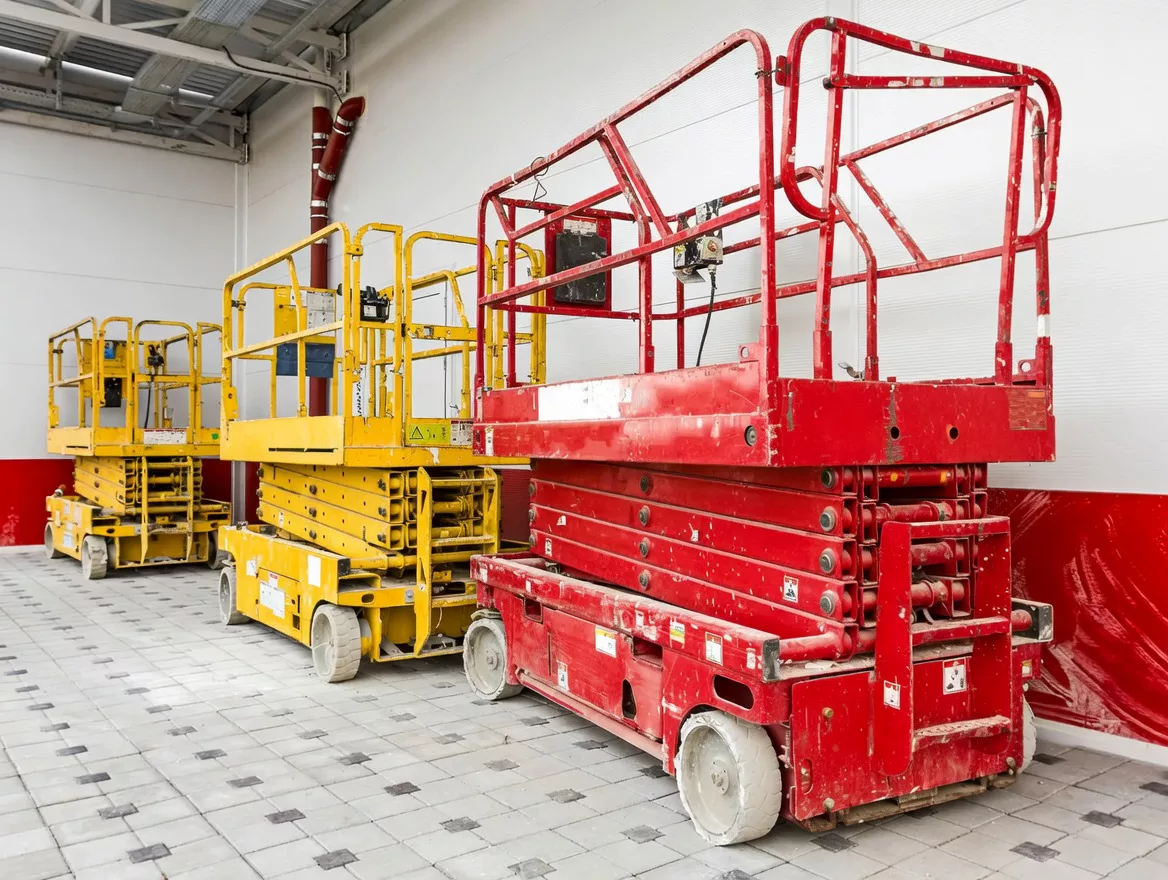
Scissor Lift Drive Configurations — Where Worm Reducers Fit
Modern scissor lift tables use one of two electromechanical drive configurations, both of which use a worm reducer as the core torque-transforming element:
Configuration A: Screw-Drive (Most Common)
The motor drives a worm gearbox whose output shaft is directly coupled to an ACME or ball screw. The screw nut is attached to the scissor cross-arm pivot. As the screw turns slowly (5–30 RPM output), the nut translates axially, forcing the scissors open (lifting) or closed (lowering). The worm gearbox provides precise slow-speed output and holds position under load when stopped.
Configuration B: Rack & Pinion via Worm Output
The worm gearbox drives a pinion engaging a toothed rack welded to the scissor arm. This configuration allows faster travel for large-stroke platforms. The worm reducer provides the ratio reduction needed to achieve very low travel speeds (0.5–2 m/min) typical of industrial lifting tables.
Variable Torque: Why Worm Gearbox Selection Must Be Generous
At the bottom of the stroke, scissor arm geometry creates the highest mechanical disadvantage — the actuating force from the screw is at its most oblique to the scissor pivot, requiring maximum torque. This starting torque can be 3–4× the torque needed at the top of the stroke. Our engineering team calculates worst-case torque at the bottom-of-stroke condition and applies an appropriate service factor to ensure the worm reducer is not undersized for the most demanding operating point.
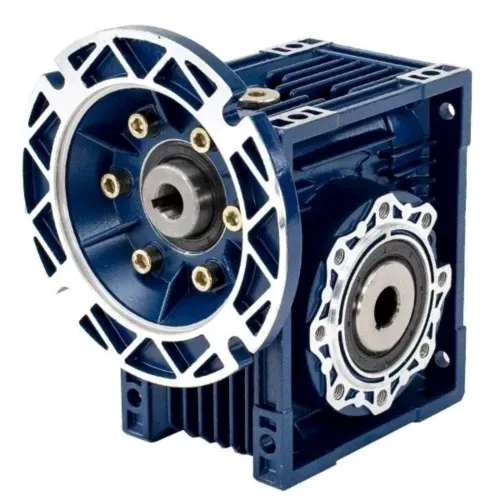
Technical Selection Guide — Worm Reducers for Scissor Lifts
| Parameter | Standard Range | Scissor Lift Guidance |
|---|---|---|
| Gear Ratio | 5:1 – 100:1 | 40:1–80:1 typical; ensures self-locking and slow screw speed |
| Output Torque | Up to 4,500 N·m | Calculate at worst-case bottom-of-stroke; apply SF 2.0–3.0 |
| Input Shaft | Ø11 – Ø55 mm | IEC B5 or B14 flange for motor direct-mount |
| Output Connection | Solid shaft / Hollow bore | Hollow bore preferred for direct screw coupling with minimal length |
| Housing | Aluminum alloy / Cast iron | Aluminum NMRV for compact design; cast iron WPA for heavy-duty |
| Duty Cycle | Intermittent (S3/S4) | Scissor lift is intermittent — 30–60 starts/hour; verify thermal class |
| IP Rating | IP54 / IP65 | IP65 for industrial floor; IP54 sufficient for warehouse indoors |
Standards & Certifications
Quality system for all manufactured worm reducers
EU Machinery Directive compliance for scissor lift integration
IEC motor flange compatibility (B5/B14/B3 mounting)
IEC 60529 ingress protection for industrial environments
Five Real Applications — Scissor Lift Performance Stories
Automotive Parts Ergonomic Lift — Czech Republic
Pain: Hydraulic scissor tables were leaking oil on clean production floor and requiring quarterly seal replacements. Solution: Electromechanical replacement using NMRV-063 worm gearbox with screw drive. Result: Zero oil leaks; maintenance interval extended to 3 years for gearbox service only.
E-Commerce Warehouse Pack Station — UK
Pain: Frequent operator back strain injuries from fixed-height packing benches processing 1,000+ items/day. Solution: Height-adjustable scissor tables with NMRV worm reducers, foot-pedal controlled. Result: Back strain incidents reduced by 80%; productivity increased 15%.
Printing Press Coil Lift Table — Germany
Pain: Heavy paper coil loading (1,200 kg) requiring 3 workers; standard lift table gearbox stripped gears at bottom-of-stroke. Solution: WPA-120 cast iron worm reducer with 60:1 ratio and SF 3.0 sizing. Result: Single-operator coil loading; zero gear failures across 5-year operating period.
Hospital Surgical Table Positioning — Singapore
Pain: Hydraulic surgical table lifts could creep down slowly during long procedures due to micro-seal leakage. Solution: Electromechanical worm reducer scissor drive — absolutely no creep under static load. Result: Regulatory compliance achieved; no position drift reported in clinical use over 18 months.
Cold Storage Transfer Lift — Canada
Pain: Scissor lift operated at -25°C cold storage facility; standard gear oil solidified and caused startup failures. Solution: Low-temperature PAO synthetic oil + cold-start bearing grease, with cold-start torque allowance. Result: Reliable operation down to -30°C; zero cold-start failures in first winter season.
Why We Are the Right Worm Gearbox Partner for Your Scissor Lift OEM
OEM Dimensioning Service
We calculate worst-case torque at bottom-of-stroke and size the unit for your specific scissor geometry.
Custom Output Flanges
Non-standard bolt patterns and hollow bore dimensions for direct integration into your scissor lift chassis.
OEM Volume Pricing
Consistent quality at factory-direct pricing for lift table manufacturers with regular production volumes.
Remote Technical Support
Engineering consultations via video for selection, installation, and performance troubleshooting.
Common Questions — Worm Gearboxes in Scissor Lift Applications
Why use a worm gearbox instead of a planetary reducer on a scissor lift?
The primary advantage of a worm gear reducer over a planetary gearbox on a scissor lift is the inherent self-locking capability at high ratios. A planetary gearbox will back-drive under load if the motor or brake fails — requiring additional electromagnetic brakes, adding cost and failure modes. The worm reducer is passive: no power needed to hold position. For applications where absolute position holding is required, the worm gearbox is the right choice.
How do I determine the gear ratio needed for my scissor lift screw drive?
The ratio is determined by the required screw speed and motor speed. For a 1,450 RPM motor and a target screw speed of 25 RPM: ratio = 1,450 / 25 = 58:1 (use nearest standard ratio of 60:1). Target screw speed comes from desired platform travel speed and screw lead (mm of travel per revolution). Share your travel speed requirement and screw lead, and we’ll calculate the exact ratio for you.
Can I use a VFD with my scissor lift worm gearbox for speed control?
Yes, VFD control is fully compatible with our worm reducers and provides smooth acceleration, deceleration, and precise position control. Ensure the motor is inverter-rated (Class F insulation) and that the VFD is set to deliver adequate torque at low speeds. Our worm gearboxes do not require any special modification for VFD operation.
What is the best output shaft configuration for connecting to a lift screw?
For screw-drive scissor lifts, a hollow-bore output shaft directly accepting the screw shaft with a keyway and locking collar is the most compact arrangement. Alternatively, a solid output shaft connected to the screw via a flexible jaw coupling allows for minor misalignment. The hollow bore solution eliminates coupling alignment requirements and reduces the total installed length — preferred for space-constrained lift table chassis.
What lubrication interval is required for a scissor lift worm gearbox?
For intermittent duty scissor lifts (S3/S4 duty), oil change intervals of 3,000–5,000 hours or every 2 years (whichever comes first) are standard with mineral VG 220 oil. With synthetic VG 220 PAO oil, intervals can extend to 5,000–8,000 hours — particularly cost-effective for high-frequency lift tables in 3-shift operations.
Design Your Scissor Lift with the Right Worm Gearbox
Provide your platform load, travel speed, and stroke length — we’ll specify the optimal worm reducer for your lift table application.