Opis
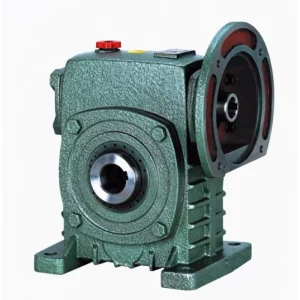
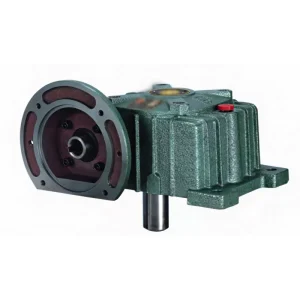
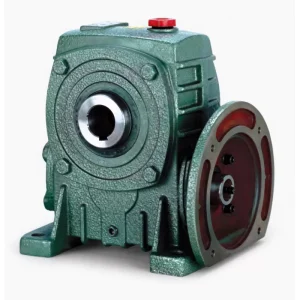
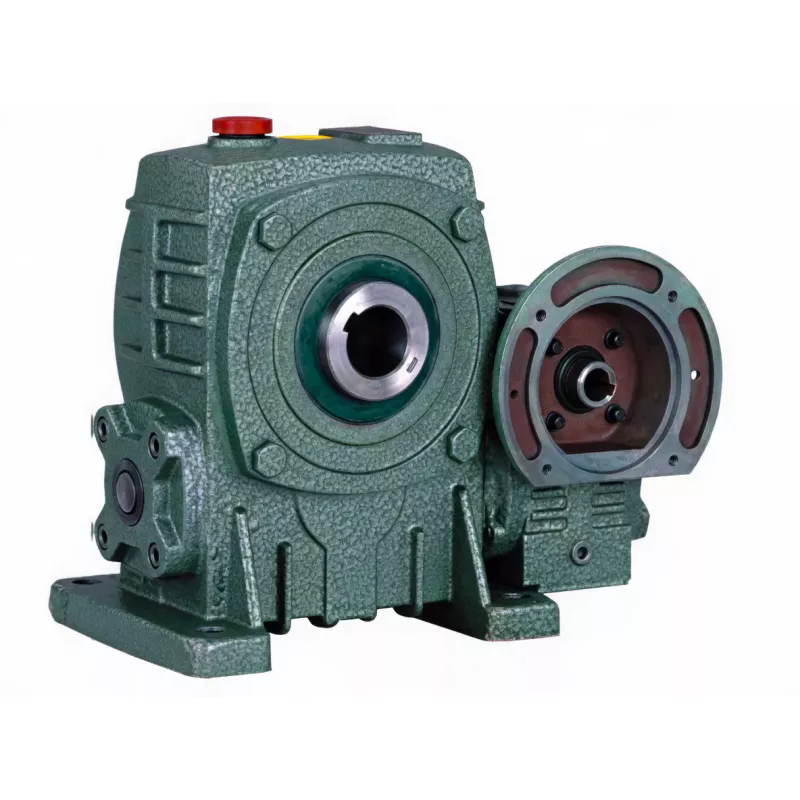
WPEDKA Flange-Mounted Hollow Shaft Double Speed Worm Gear Reducer — Zero Couplings at Both Ends with Ultra-High Two-Stage Ratio
The WPEDKA is the product in the WPE two-stage family that eliminates couplings at both the motor input and the driven shaft output simultaneously — while delivering the extreme 1/200–1/900 reduction ratios that no single-stage product can achieve. The IEC motor flange at the input eliminates the motor coupling; the H7 hollow output bore eliminates the output shaft coupling. The complete drive chain from motor to process shaft consists of just three components: motor + WPEDKA + driven shaft.
This maximum integration makes the WPEDKA the ideal solution for automotive conveyor lines, logistics automation, and high-density material handling systems where every eliminated coupling reduces maintenance events across hundreds of installed drive points. Available in 9 size groups, motors 0.12–5.5 kW, bore 30–110 mm, ratios 1/200–1/900. O Ever-power | Request a Quote
Technical Specifications
IEC flange dimensions: LA=flange OD; LB=pilot OD; LC=bolt circle; LE=bolt count; LZ=bolt size. Input hole: Q, U, T×V. Hollow output bore: S (H7 tolerance); W×Y = bore keyway. All in mm; reference speed 1500 r/min.
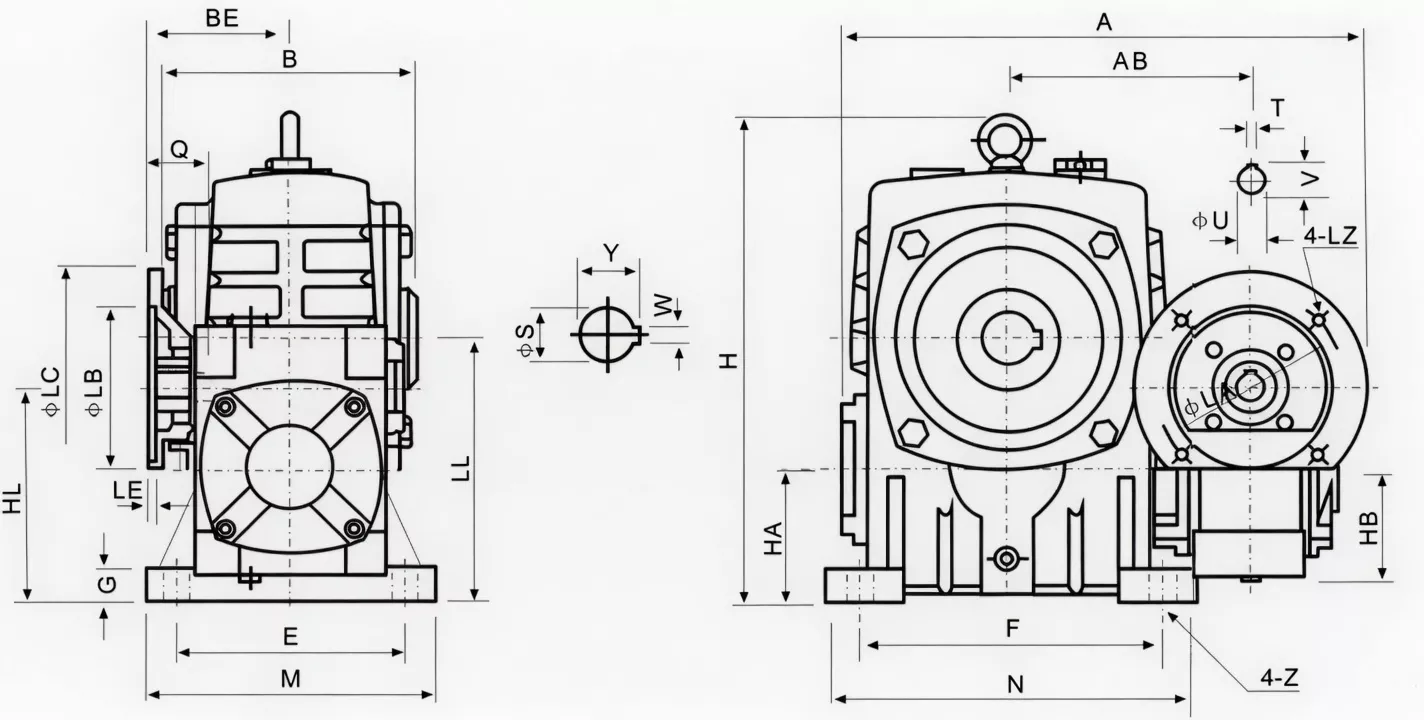
| Size | Power(kW) | Ratio | A | AB | B | BE | HL | LL | H | HA | HB | M | N | E | F | G | Z | LA | LB | LC | LE | LZ | Q | U | T×V | S(bore) | W×Y(keyway) | Wt(kg) |
|---|---|---|---|---|---|---|---|---|---|---|---|---|---|---|---|---|---|---|---|---|---|---|---|---|---|---|---|---|
| 40-70 | 0.12 | 1/200–1/900 | 314 | 153 | 130 | 75 | 110 | 140 | 236 | 70 | 55 | 150 | 190 | 115 | 150 | 20 | 15 | 115 | 95 | 140 | 4 | M8 | 31 | 11 | 4×12.8 | 30 | 8×33.3 | 19 |
| 50-80 | 0.18 | 314 | 144 | 150 | 83 | 130 | 160 | 268 | 80 | 65 | 170 | 220 | 135 | 180 | 20 | 15 | 115 | 95 | 140 | 4 | M8 | 31 | 11 | 4×12.8 | 35 | 10×38.3 | 27 | |
| 60-100 | 0.37 | 1/200 | 387 | 175 | 160 | 91 | 160 | 200 | 336 | 100 | 75 | 190 | 270 | 155 | 220 | 25 | 15 | 130 | 110 | 160 | 4 | M8 | 33 | 14 | 5×16.3 | 40 | 12×43.3 | 45 |
| 70-120 | 0.37/0.75 | 1/300–1/400 | 425/445 | 193 | 175 | 109/111 | 190 | 240 | 430 | 120 | 93 | 230 | 320 | 180 | 260 | 30 | 18 | 130/165 | 110/130 | 160/200 | 4 | M8/M10 | 40/42 | 14/19 | 5×16.3/6×21.8 | 45 | 14×48.8 | 75 |
| 80-135 | 0.75/1.5 | 1/500–1/600 | 499 | 226 | 210 | 125 | 215 | 270 | 480 | 135 | 130 | 250 | 350 | 200 | 290 | 30 | 18 | 165 | 130 | 200 | 4.5 | M10 | 48/52 | 19/24 | 6×21.8/8×27.3 | 60 | 18×64.4 | 103 |
| 100-155 | 1.5 | 1/800 | 570 | 269 | 256 | 148 | 235 | 290 | 531 | 135 | 130 | 275 | 390 | 220 | 320 | 35 | 21 | 165 | 130 | 200 | 4.5 | M10 | 52 | 24 | 8×27.3 | 70 | 20×74.9 | 147 |
| 120-175 | 2.2/3.0 | 1/900 | 631 | 287 | 282 | 181 | 280 | 335 | 600 | 160 | 155 | 310 | 430 | 250 | 350 | 40 | 21 | 215 | 180 | 250 | 5 | M12 | 63 | 28 | 8×31.3 | 80 | 22×85.4 | 204 |
| 135-200 | 3.0/4.0 | 680 | 318 | 320 | 202 | 310 | 375 | 666 | 175 | 165 | 360 | 480 | 290 | 390 | 40 | 24 | 215 | 180 | 250 | 5 | M12 | 63 | 28 | 8×31.3 | 85 | 22×90.4 | 298 | |
| 155-250 | 5.5 | 815 | 380 | 400 | 247 | 355 | 450 | 800 | 200 | 203 | 460 | 560 | 380 | 480 | 45 | 28 | 265 | 230 | 300 | 5 | M12 | 83 | 38 | 10×41.3 | 110 | 28×116.4 | 470 |
* S = hollow output bore H7 tolerance; driven shaft must be ground to h6/js6. LA, LB, LC per IEC 60034-7. HA and HB = front/rear housing height offsets. Both interfaces (motor flange input AND hollow bore output) verified before shipment.
Product Structure — Motor Flange In, Hollow Bore Out, Two-Stage Through
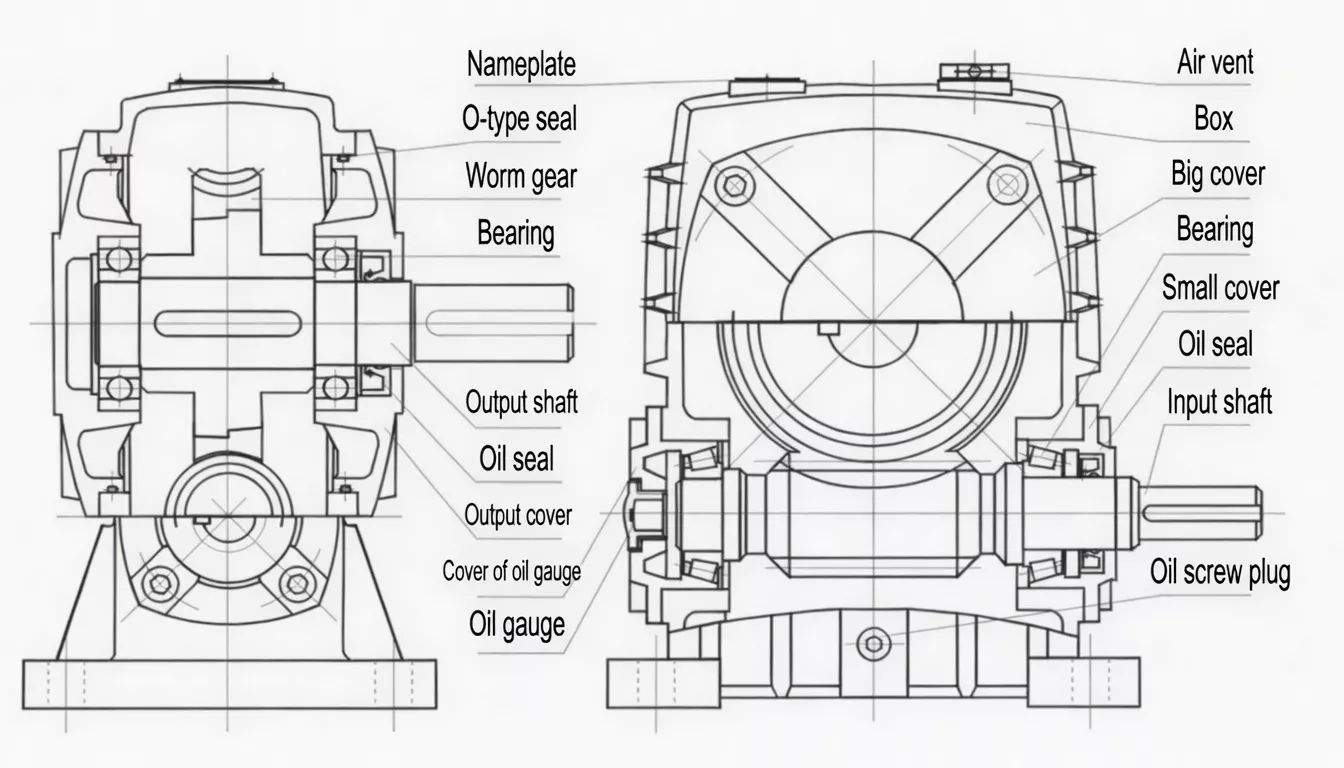
The WPEDKA is the integration of the WPEDA (motor-direct two-stage) with the WPEKA (hollow shaft two-stage) in a single casting — with an IEC motor flange at the first-stage input and an H7 hollow bore at the second-stage output. Motor shaft in at the front; driven shaft in at the back; two-stage ultra-high ratio in between. Three components, zero couplings, zero alignment steps.
| Input | IEC 60034-7 motor flange + keyed bore — motor direct, no input coupling |
| Drive | Two worm-and-wheel stages in series; ratio 1/200–1/900 |
| Output | H7 hollow bore + keyway; 30–110 mm — driven shaft direct, no output coupling |
| Result | Motor + WPEDKA + driven shaft — 3 components, 0 couplings |
| Housing | FC25 cast iron; elongated two-stage body with flange at input, bore at output |
| Motor Range | 0.12 kW (size 40-70) to 5.5 kW (size 155-250) |
✅ Key Features & Benefits
Zero Couplings at Both Ends with 1/200–1/900 Ratios
The WPEDKA is unique in eliminating couplings at both the motor input (IEC flange) and the driven shaft output (hollow bore) while simultaneously achieving two-stage 1/200–1/900 reduction. No other product type achieves this three-feature combination. Keywords: motor-direct hollow shaft double speed worm gearbox, zero-coupling two-stage reducer.
IEC Flange — 15-Minute Motor Swap
In high-density material handling systems with dozens of identical drive points, the IEC flange enables motor replacement in under 15 minutes — no coupling removal, no alignment re-check. Across a 50-unit conveyor system, this reduction in per-motor maintenance time has significant measurable value.
H7 Hollow Bore — Direct Shaft Engagement
The H7 precision hollow bore accepts conveyor roller shafts, material handling drive shafts, and logistics equipment shafts from 30 mm to 110 mm ground to h6/js6 — with no field reaming, no coupling hub, and no alignment tooling required at the output end.
Eliminates Both Coupling Costs Simultaneously
One WPEDKA replaces a gearbox PLUS two couplings (one motor-side, one shaft-side). For OEM machine builders sourcing hundreds of drive units for a logistics facility or automotive line, eliminating two coupling SKUs from the BOM and two coupling maintenance procedures from the service manual is a compelling TCO argument.
FC25 Cast Iron for Industrial Conveyor Environments
The elongated two-stage FC25 housing withstands the vibration, dust, and intermittent shock loads typical of automotive conveyor and logistics automation environments — where multiple drive units operate simultaneously under variable load conditions.
Full Motor Range 0.12–5.5 kW
Nine size groups accept motors from 0.12 kW (small positioning and indexing drives) to 5.5 kW (heavy conveyor roller drives) — covering the entire range of material handling and logistics automation drive requirements.
Industry Applications
The WPEDKA is the preferred specification for high-density material handling and logistics systems where zero-coupling simplicity at both drive ends reduces maintenance at scale:
Automotive Assembly LinesCar body welding conveyor roller drives, engine line transport systems, and trim assembly conveyor drives where hundreds of identical WPEDKA zero-coupling drive units simplify both installation and maintenance at scale.
Logistics & Fulfilment CentresE-commerce fulfilment conveyor sorting drives, high-density roller conveyor accumulation systems, and automated warehouse pallet conveyor drives requiring ultra-high ratio compact zero-coupling direct drives.
Material Handling OEM EquipmentConveyor system OEM builders and material handling integrators who want to reduce their machine BOM complexity by eliminating both the motor coupling and the output shaft coupling across their entire product range.
Automated Manufacturing LinesBattery production line conveyor drives, electronics assembly conveyor systems, and new energy vehicle battery pack assembly line transport drives requiring compact, low-maintenance zero-coupling drives.
Heavy Roller Conveyor DrivesHeavy-duty live roller conveyor drives, large carton accumulation system drives, and heavy pallet handling conveyor drives where the WPEDKA’s zero-coupling design eliminates the two most common maintenance call-outs on high-density conveyor systems.
Agri & Food Production LinesAutomated food production line transport drives, poultry processing conveyor drives, and dairy production line conveyor systems requiring compact, maintenance-minimised zero-coupling motor-direct hollow shaft drives.
Quality Control & Certification
ISO 9001:2015 & CE
Full ISO 9001:2015 QMS. CE Declaration of Conformity per shipment. Automotive and logistics industry supply chain documentation available. The WPEDKA is the only WPE product requiring simultaneous IEC flange and hollow bore dimensional verification.
Dual Interface Run Test
Each WPEDKA undergoes: (1) IEC flange concentricity CMM check (≤0.05 mm TIR), (2) hollow bore H7 plug gauge, (3) bore concentricity check (≤0.05 mm TIR), (4) 45-min two-stage run test — noise ≤75 dB(A), seal integrity, torque ±5%. Both interface dimensions AND gear performance verified on every unit.
OEM Batch Consistency
For automotive and logistics OEM batch supply, we maintain batch-to-batch dimensional consistency records for both the IEC flange and hollow bore interfaces. OEM customers can specify a dimensional consistency window tighter than our standard tolerance for high-volume automated assembly line supply programmes.
Why Choose Ever-power for WPEDKA Gearboxes
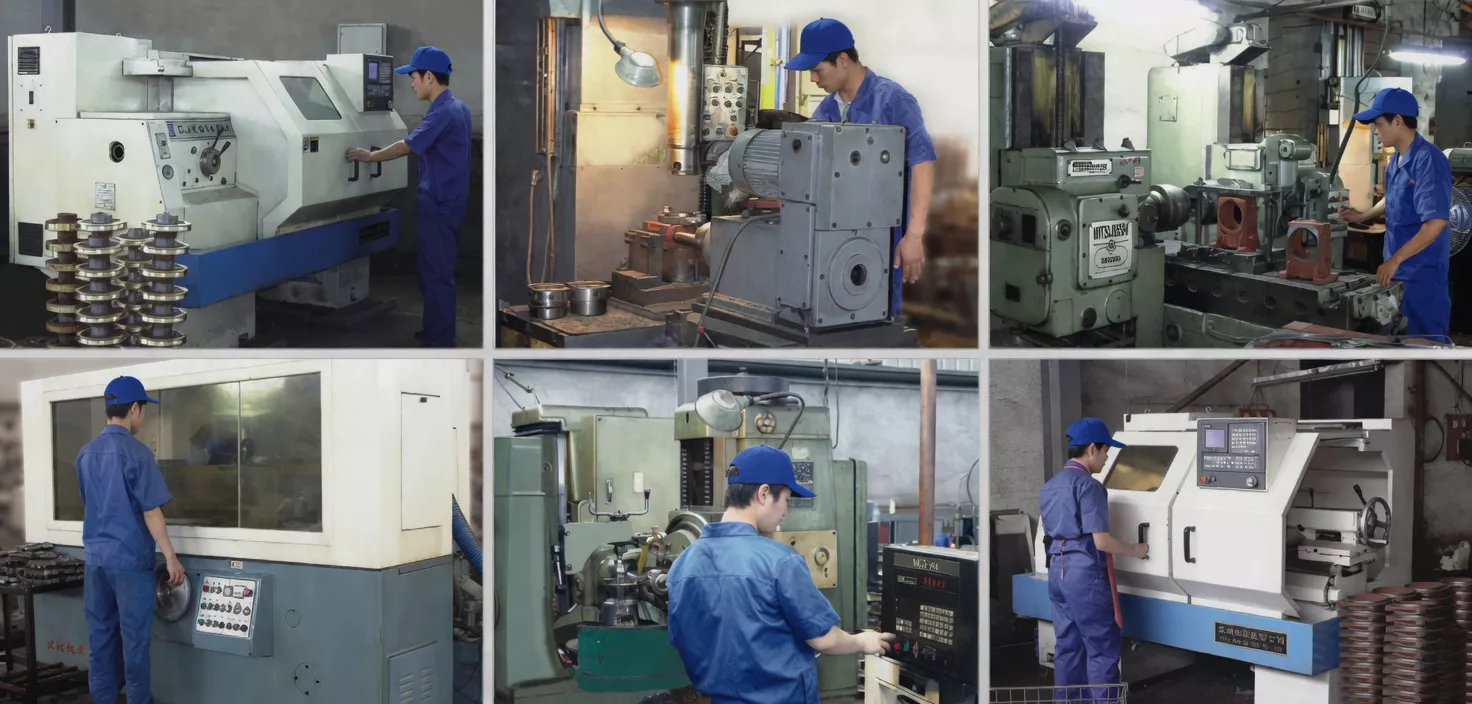
We supply WPEDKA zero-coupling two-stage gearboxes to automotive conveyor OEMs, logistics automation equipment builders, and material handling systems integrators in Germany, the USA, Australia, Spain, and over 60 countries. Our dual interface verification — IEC flange concentricity AND hollow bore H7 — ensures WPEDKA units deliver both motor fit accuracy and output shaft fit accuracy in every single unit shipped.
- ✅ Dual interface CMM verification — IEC flange AND hollow bore, every unit
- ✅ Automotive & logistics OEM supply — batch consistency documentation
- ✅ Custom bore diameters for non-standard conveyor roller shaft sizes
- ✅ Anti-gall grease kit included on request for motor shaft insertion
- ✅ 20+ years export record — Germany, USA, Australia, Spain and beyond
⭐ Customer Reviews
“We switched our entire heavy roller conveyor drive specification to WPEDKA units. Removing both motor coupling and output coupling cut our drive installation time by 70% per unit and eliminated our two most frequent field failure modes. At 1/400 ratio, the conveyor speed is exactly what our client’s accumulation system requires. The bore tolerance is consistently H7. Outstanding product.”
Craig W., Systems Engineer
Conveyor Systems Integrator, New South Wales, Australia
“We specify WPEDKA as standard for all zero-coupling conveyor drives on our automotive body line systems. The IEC flange motor mounting and hollow bore shaft engagement eliminate two coupling components from every drive point — across a full car body line with 80+ drives, this is a significant simplification. Consistent quality and dimensional accuracy from Ever-power across multiple project supply programmes.”
Stefan M., Machine Design Lead
Automotive Conveyor OEM, Stuttgart, Germany
“WPEDKA gearboxes in our high-density fulfilment centre conveyor systems. The zero-coupling design at both ends is essential for our maintenance-in-place conveyor topology where coupling access is extremely limited. The two-stage ratio gives us the very slow accumulation conveyor speed our sortation logic requires. Very satisfied with quality and reliability.”
Marcus H., Logistics Engineer
Fulfilment Centre Equipment, Ohio, USA
“We use WPEDKA for our automated grocery warehouse conveyor drives. The dual zero-coupling concept is ideal for high-density automated warehouse drives where maintenance access is restricted. Good quality, IEC flange and bore dimensions are correct. One batch had a slightly longer delivery than stated but Ever-power communicated proactively and resolved.”
Pablo G., Technical Manager
Material Handling OEM, Barcelona, Spain
❓ Frequently Asked Questions
What makes the WPEDKA different from WPEDA and WPEKA?
The WPEDA has an IEC flange at input and a solid shaft at output. The WPEKA has a standard input shaft and a hollow bore at output. The WPEDKA has both: IEC flange at input AND hollow bore at output — eliminating couplings at both ends simultaneously. It is the only WPE two-stage product that achieves zero couplings in the entire motor-to-driven-shaft chain.
How do I install the motor and driven shaft on the WPEDKA?
Installation: (1) Apply anti-gall grease to the motor shaft; insert motor shaft into the IEC input bore; tighten flange bolts to specified torque. (2) Apply anti-gall grease to the driven shaft; insert driven shaft into the H7 hollow output bore; engage the keyway; tighten the set screw (or fit shrink disc if specified). The total installation time for both interfaces is typically 20–30 minutes — no alignment tooling, no coupling selection, no coupling installation.
Is the WPEDKA suitable for high-density automated systems with many identical drive units?
Yes — the WPEDKA is particularly well-suited to high-density automated systems. Identical installation procedure at every drive point (same motor bolting sequence, same shaft insertion sequence) enables consistent installation quality across hundreds of units. We maintain batch-to-batch dimensional consistency records for OEM customers requiring identical fit across large-scale supply programmes.
What is the maximum hollow bore diameter available for WPEDKA?
The largest standard bore is 110 mm for size 155-250. For logistics and conveyor applications, the most common bore sizes are 30–60 mm (sizes 40-70 through 80-135), matching standard conveyor roller shaft diameters. Custom bore diameters are available for OEM orders — contact us with your shaft diameter for availability and lead time.
Can I use the WPEDKA with a VSD/inverter on automotive conveyor lines?
Yes — the WPEDKA is fully compatible with VSD operation for variable-speed conveyor control. The IEC flange accepts all standard IE2/IE3 VSD-rated motors. For continuous low-speed VSD duty (below 30 Hz), note reduced TEFC motor cooling — for automotive conveyor applications running VSD at very low speeds continuously in warm plant rooms, consider the WPEDKS (finned variant) for additional thermal headroom.
Zero Couplings at Both Ends + Ultra-High Ratio — Get WPEDKA Quote
Simplify your drive chain to three components — motor, WPEDKA, driven shaft. Our engineers will verify motor flange compatibility, bore size, and provide a free selection calculation for your conveyor or material handling application.