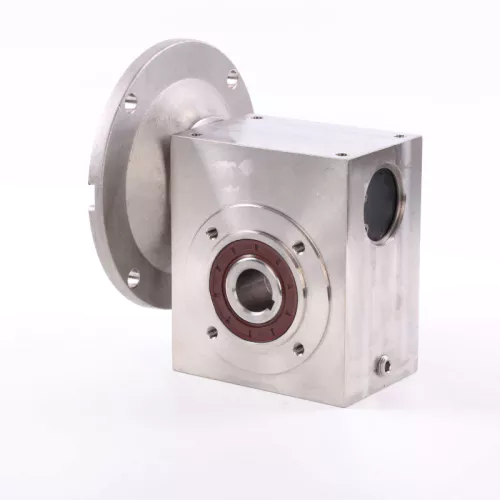
Worm Gear Reducer for Automatic Labeling Machines — Silent Precision for High-Speed Label Application
A mislabeled product is more than a quality defect — in pharmaceutical and food applications it can trigger a product recall. Automatic labeling machines therefore demand absolute consistency from every component in the drive train, and the worm gear reducer driving the label roll, dispense drum, and product conveyor is no exception. Low noise (labels are applied in open factory spaces where workers operate nearby), precise speed synchronization between conveyor belt and label web, and seamless compatibility with stepper or servo motor drive systems are the three non-negotiable performance criteria. Our worm gearboxes are engineered to meet all three — delivering quiet, backlash-minimised, flange-compatible precision drive for labeling equipment across pharmaceutical, food & beverage, cosmetics, and industrial sectors.

Label Machine Drive Architecture — Where Worm Reducers Are Used
A typical wrap-around or front-and-back automatic labeling machine contains up to four distinct drive zones, each served by a dedicated worm gear unit:
Controls the tension of the label web as it unwinds from the supply roll (up to 600 mm diameter) and rewinds the liner. Requires smooth, ripple-free speed — any pulsation causes label pitch error and misregistration.
The drum or tamp mechanism that peels the label from the liner and applies it to the product. Speed must be synchronised to within ±0.2 % of conveyor speed for consistent label placement.
Moves the product through the labeling station at controlled speed. A worm reducer with stepper motor gives precise speed steps for variable product sizes without encoder feedback.
For wrap-around labeling, rollers spin the container while the label is applied. Worm drive provides smooth, jerk-free rotation essential for wrinkle-free label application on cylindrical containers.
The worm wheel material is tin bronze ZCuSn10Pb1, chosen specifically for its inherently low sliding noise characteristic. During mesh engagement, the bronze-on-steel sliding contact produces significantly less acoustic energy than steel-on-steel helical gear pairs — a critical advantage in open-plan factory environments. Noise levels at 1 m distance are typically below 58 dB(A) for labeling machine duty cycles (low torque, moderate speed).
The housing is die-cast aluminium ADC12 in virtually all labeling machine applications — the low weight and precise casting dimensional accuracy (±0.2 mm) simplify integration into the aluminium-profile machine frame architecture favoured by labeling machine designers. IEC B14 small-flange input is the standard interface, allowing direct coupling with NEMA 23 / IEC 60 frame stepper motors or compact servo motors without an adaptor.
Technical Specifications — Labeling Machine Worm Reducers
| Parameter | Full Range | Label Machine Typical | Performance Target |
|---|---|---|---|
| Gear Ratio | 5:1 – 100:1 | 5:1 – 20:1 | Label web speed 0.3–2.0 m/s |
| Output Torque | 10 – 4 500 N·m | 5 – 80 N·m | Light load — speed accuracy key |
| Backlash | Standard / Low (<0.5°) | Low-backlash <0.5° | Label pitch registration ±0.5 mm |
| Input Flange | IEC B14 / B5 / NEMA | IEC B14 (compact) | Stepper / servo motor direct coupling |
| Housing Material | Aluminium / Cast iron | Die-cast aluminium ADC12 | Machine frame weight budget |
| Noise Level | <68 dB(A) @ 1 m | <58 dB(A) labeling duty | Open-plan factory acoustic limit |
| IP Rating | IP55 / IP65 | IP65 | Label adhesive and cleaning spray protection |
Speed Synchronisation & Stepper Motor Compatibility
For label registration accuracy, the label web speed must match conveyor speed to within ±0.5 mm per label pitch. This requires either: (a) a closed-loop servo system with encoder feedback — worm reducer’s low backlash (<0.5°) is essential so the servo does not hunt; or (b) an open-loop stepper motor system — worm reducer ratio must be selected so the stepper’s step resolution (typically 1.8°/step or 0.9° with half-step) produces a label web increment fine enough for the required label pitch. We provide step-per-mm calculation sheets for standard label pitches. Contact our engineering team for label-specific calculation support.
Quality Standards & Compliance
Labeling machine OEMs — particularly those serving pharmaceutical and food clients — require rigorous documentation. Our standard package includes:
- ISO 9001:2015 Certificate — manufacturing quality system
- CE Declaration of Conformity — EU Machinery Directive 2006/42/EC
- Motor flange dimensions to IEC 72-1 (B14 and B5) — stepper and servo compatible
- IP65 ingress protection certificate (IEC 60529) — label adhesive and spray resistant
- Dimensional drawing with GD&T tolerances — supports machine CE technical file
- Material data sheet for housing alloy and worm wheel bronze
Five Labeling Machine Case Studies
Challenge: Servo-driven wrap-around labeler hunted at low speed due to 1.1° reducer backlash — label wrinkle on 20 % of vials. Solution: Low-backlash worm reducer <0.3°, IEC B14, ratio 10:1. Result: Label wrinkle rate fell to <0.01 %; servo loop stable across full speed range.
Challenge: 95 dB(A) machine noise in open bottling hall exceeded occupational health limit; reducer noise identified as primary contributor. Solution: Low-noise worm reducer (precision-lapped gear pair), aluminium housing, synthetic PAO oil. Result: Reducer noise contribution reduced to 54 dB(A); overall machine noise at 78 dB(A) — within OHS limit without enclosure.
Challenge: Wax-release adhesive built up around the output shaft of the unwind drive, jamming the seal within 3 months. Solution: IP65 reducer with PTFE-lined seal and extended labyrinth shield on output shaft. Result: 28 months of operation without adhesive seal jam; scheduled annual inspection only.
Challenge: Stepper motor stalled at high sleeve tension — existing 5:1 worm reducer had insufficient torque multiplication. Solution: Upgraded to 10:1 ratio (doubled torque at same motor), low backlash. Result: Zero stall events in 14 months; label registration improved from ±1.2 mm to ±0.4 mm.
Challenge: ESD-sensitive cells required vibration <0.5 mm/s at the labeling station; worm reducer vibration exceeded limit at 450 cpm. Solution: Vibration-damping rubber mounting pads + precision-lapped worm pair; vibration at 0.18 mm/s. Result: Cell rejection from label-station vibration dropped from 0.3 % to zero.
Why Labeling Machine Designers Trust Our Worm Drives
Quiet By Design
Bronze-on-steel worm mesh is inherently quieter than helical or spur alternatives — no acoustic enclosure needed at standard labeling speeds.
Low Backlash Assembly
Sub-0.5° backlash options for servo and stepper label registration — assembled and tested to specification before shipment.
Stepper / Servo Ready
IEC B14 and NEMA C-face flanges fit standard label machine stepper and servo motors without adaptors or custom machining.
OEM Programme
Private-label nameplates, kitted motor-reducer assemblies, and application-matched ratio selection for labeling machine OEM builders.
Pharma Documentation
Material certs, CE declarations, ISO 9001 factory cert — supporting pharmaceutical and food labeling machine validation packages.
Volume OEM Pricing
Tiered pricing from 1 unit prototype to 1 000+ unit annual runs — factory-direct margins with no distributor markup.
Frequently Asked Questions
What ratio gives me 0.5 m/s web speed with a 200-step/rev stepper motor?
With a 60 mm diameter label drum, the circumference = π × 60 = 188.5 mm. To achieve 0.5 m/s = 500 mm/s, the drum must rotate at 500 / 188.5 = 2.65 rev/s = 159 rpm. A 200-step motor at 1 600 steps/s (8 full revolutions/s) with a ratio of 8 / 2.65 = 3.0 — use ratio 3:1 or 5:1 (with step rate adjusted). We provide a step-rate calculator spreadsheet on request to fine-tune web speed for any label pitch and drum diameter combination.
How does label adhesive affect the worm reducer seals?
Label adhesives (acrylic, hot-melt, rubber-based) can migrate to the output shaft seal area and cause seal hardening or adhesive buildup that mechanically wears the seal lip. Prevention measures: (1) IP65 rated labyrinth + double-lip seal stack on the output shaft — keeps adhesive contact to a minimum; (2) PTFE-coated seal lips for reduced adhesive adhesion; (3) a sheet metal drip shield mounted above the shaft exit. We stock all three options — specify your adhesive type when ordering for the correct seal material recommendation.
What is the noise level difference between worm and helical gearboxes for labeling duty?
Under typical labeling machine duty (5–50 N·m output torque, 100–500 rpm input), well-maintained worm reducers run at 54–62 dB(A) at 1 m, versus 65–75 dB(A) for equivalent helical or bevel-helical units. The difference arises from the sliding contact nature of worm gearing — the smooth bronze-on-steel mesh generates lower impact noise than the rolling-contact tooth engagement of helical gears. This 8–12 dB(A) advantage is significant in open-plan labeling halls where ambient noise limits are enforced.
Can your worm reducers handle the rapid acceleration cycles of a servo-driven dispense drum?
Yes — for servo-driven dispense drums that accelerate and decelerate within milliseconds, the key parameter is the reducer’s reflected inertia at the motor shaft (Jr = Joutput / i²). Low inertia at the motor shaft means the servo can accelerate rapidly without exceeding current limits. Our aluminium-housing worm reducers have lower rotational inertia than cast-iron equivalents — specify aluminium housing for servo dispense drum applications and provide your servo motor’s maximum inertia ratio for confirmation.
Do you offer kitted motor-reducer assemblies for labeling machine OEMs?
Yes — we assemble, test, and ship matched motor-reducer units (gearmotors) for labeling OEM builders. Options include: stepper motor (NEMA 23/34) + worm reducer; servo motor (IEC 60 frame) + low-backlash worm reducer; with custom cable length, connector type, and mounting bracket as specified. All units are run-in tested and shipped with a gear mesh inspection report. Minimum order 1 unit for prototyping; volume pricing from 10 units.
Precision Worm Drives for Your Labeling Machine
Share your label pitch, web speed, motor type (stepper/servo), and label machine model — we provide ratio selection, backlash specification, and step-rate calculation within 24 hours.
Learn about our ISO 9001 factory and OEM programme at the About Us page.