Worm Gear Reducer for Baking Oven Conveyor Belts — Reliable Drive for High-Temperature Tunnel Ovens
Tunnel baking ovens stretch the capabilities of industrial drive systems to their limit. A commercial bread oven may be 60–100 metres long, operate continuously at 220–280 °C, and carry a metal mesh belt laden with thousands of bread loaves moving at just 2–8 m/min. The worm gear reducer at the head-drive station must sustain reliable operation in this extreme environment — near a radiant heat source, in flour-laden air, potentially exposed to steam — with oil that must not degrade or thin excessively, seals that maintain integrity at elevated temperatures, and a structure that doesn’t warp under thermal cycling. This page explains how to correctly specify a worm gearbox for baking oven conveyor applications and what distinguishes our products in this challenging duty.
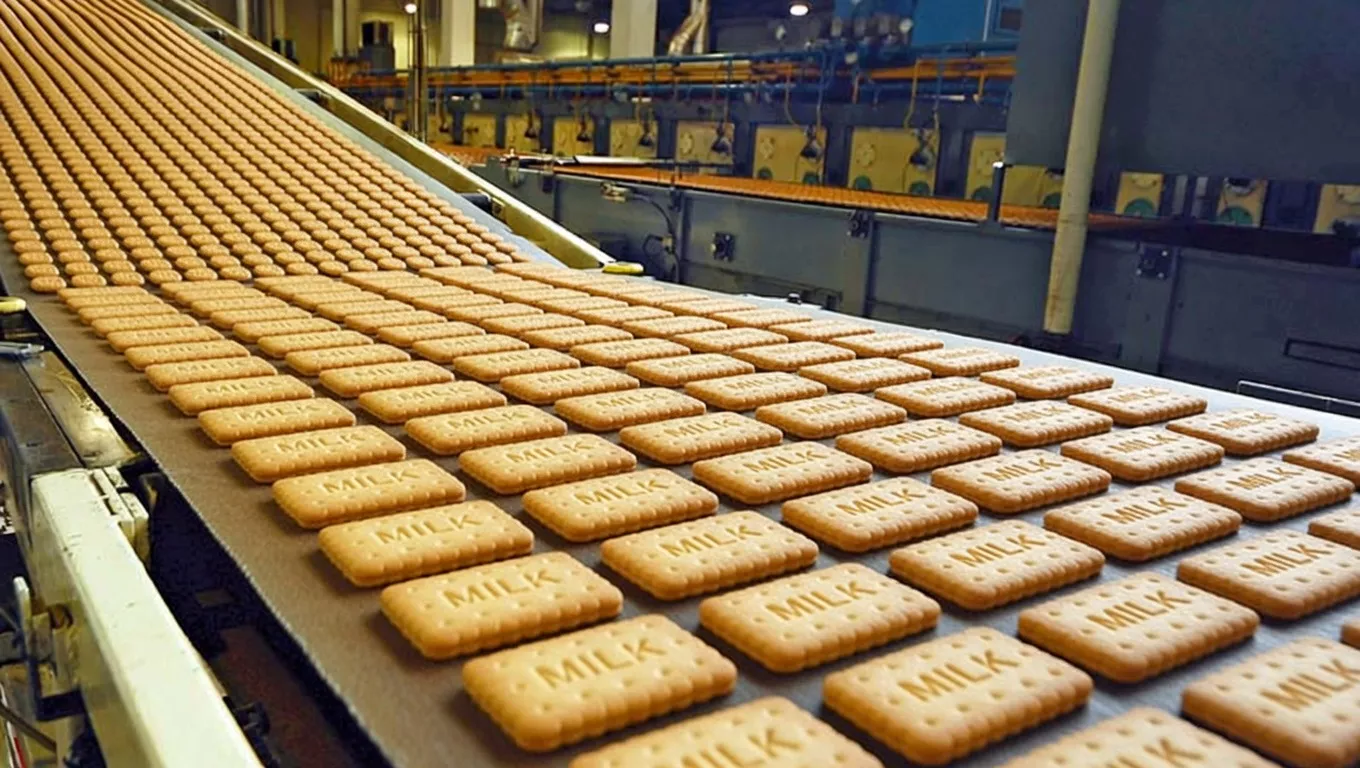
Baking Oven Drive — The Unique Technical Challenge
The tunnel oven presents a combination of stresses not found in any other food equipment application:
Materials and construction details for oven-duty worm gear drives:
- Worm wheel: Centrifugally cast ZCuSn10Pb1 bronze — stable at elevated oil temperatures, no thermal degradation of the alloy up to 150 °C continuous
- Worm shaft: 20CrMnTi, case-carburised, precision ground — heat treatment unaffected by proximity to oven at normal installation distances (>200 mm from oven wall)
- Housing: EN-GJL-250 grey cast iron — low thermal expansion (11 µm/m·°C vs. 24 µm/m·°C for aluminium), superior rigidity under thermal cycling, excellent heat dissipation through fin structure
- Seals: High-temperature FKM (rated to 200 °C continuous) or PTFE lip seals for temperatures above 150 °C ambient — specified based on measured drive installation temperature
- Lubricant: ISO VG 460 PAO synthetic (rated to 120 °C continuous oil sump temperature); for extreme oven proximity, PFPE (perfluoropolyether) grease packing of bearings
- Breather / vent: High-temperature silica-gel breather to prevent moisture condensation during cool-down cycles
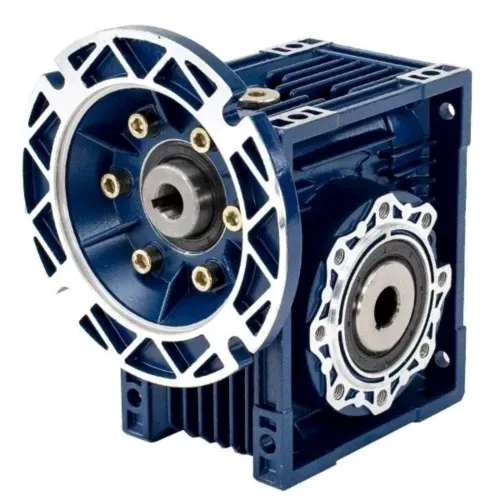
Technical Specifications — Baking Oven Worm Gear Reducers
| Parameter | Standard Range | Tunnel Oven Typical | Special Requirement |
|---|---|---|---|
| Gear Ratio | 5:1 – 100:1 (single stage) | 60:1 – 100:1 or double-stage | Belt speed 2–8 m/min from 4-pole motor |
| Output Torque | 10 – 4 500 N·m | 300 – 2 000 N·m | Include belt tension in torque calculation |
| Housing Material | Aluminium / Cast iron | Cast iron GJL-250 | Low thermal expansion; high heat capacity |
| Lubricant | ISO VG 220 / PAO 220–460 | PAO ISO VG 460 (high-temp) | PFPE for >90 °C ambient |
| Shaft Seal | NBR / FKM / PTFE | FKM (≤150 °C) / PTFE (≤200 °C) | Specify measured drive ambient temperature |
| IP Rating | IP55 / IP65 | IP65 | Flour dust + steam condensate exclusion |
| Breather | Standard / High-temp silica-gel | High-temp silica-gel breather | Prevents condensation on cool-down |
| Mounting | Foot / Flange / Shaft | Foot-mounted on oven drive frame | Thermal isolation pads recommended |
Temperature guide: If measured ambient <50 °C → FKM seal + PAO 460; 50–80 °C → PTFE seal + PAO 460 + external cooling; >80 °C → PFPE grease bearing + thermal isolation bracket. Consult engineering team for site-specific thermal analysis.
Quality & Compliance Standards
| Standard / Certification | Relevance to Oven Applications |
|---|---|
| ISO 9001:2015 | Full production QMS; traceability of all components |
| CE Marking | EU machinery directive compliance for food equipment |
| IEC B5 / B14 Motor Flanges | Direct coupling to IEC standard motors used in oven drives |
| IP65 (IEC 60529) | Flour dust ingress protection validated |
| NSF H1 Lubricant Option | Food-grade oil for bakeries with strict HACCP requirements |
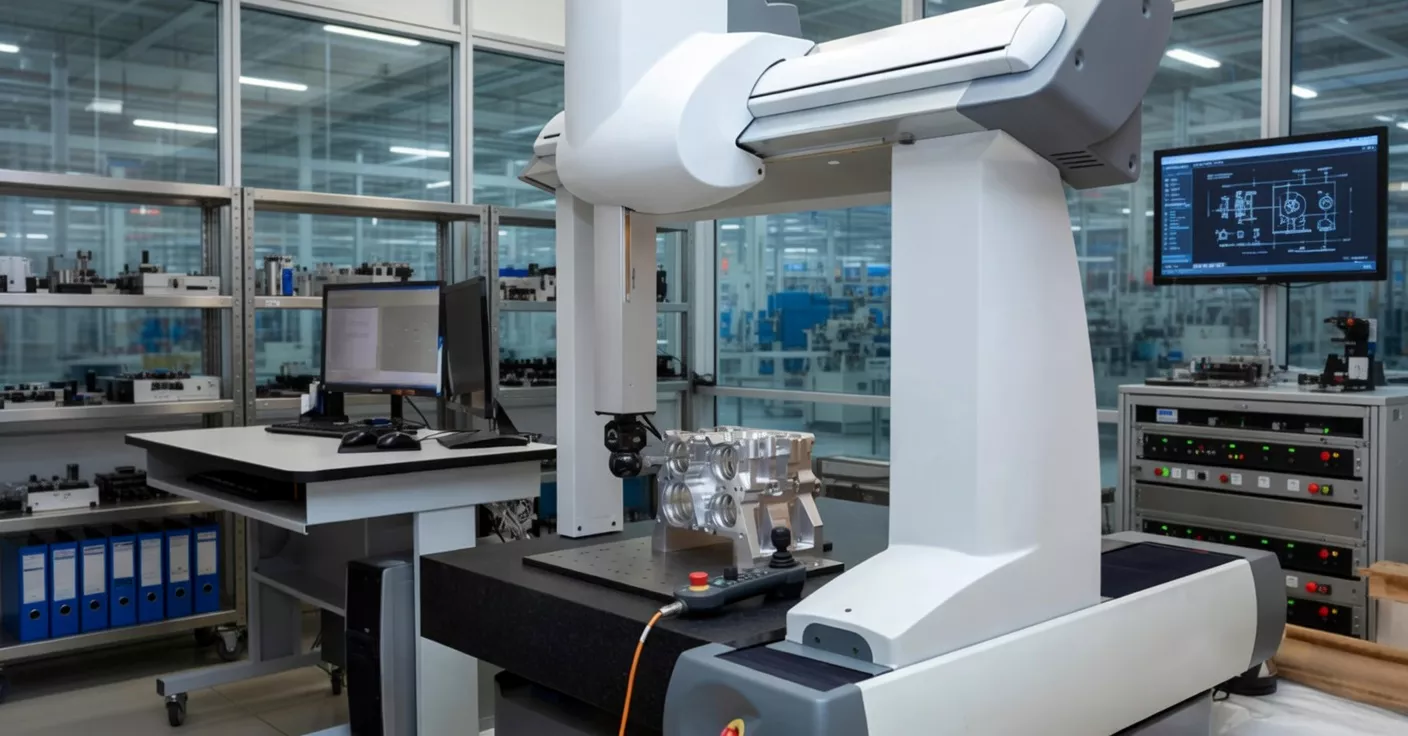
Five Baking Oven Case Studies
Industrial Bakery — 80 m Baguette Oven, France
Challenge: Steel mesh belt drive seized twice per season as lubricant degraded at 70 °C ambient. Solution: PAO 460 synthetic + FKM seals + high-temp breather. Result: 36 months without lubricant-related failure; oil change once per year vs. every 3 months previously.
Biscuit Line — Wire-Mesh Belt Oven, UK
Challenge: Old worm drive output shaft warped under thermal cycling — misalignment caused belt weave and product waste. Solution: Upgraded to cast-iron housing with larger output shaft diameter (55 mm vs. 40 mm) and thermally isolated mounting bracket. Result: Belt weave eliminated; biscuit breakage rate dropped 1.8 %; reducer has run 22 months without alignment correction.
Croissant Bakery — Proofer & Oven Combination, Netherlands
Challenge: Proofer (40 °C / 90 % RH) and oven (250 °C) on same drive train; NBR seals failed from humidity on the proofer section. Solution: Two separate worm reducers — FKM-sealed unit for the oven drive, EPDM-sealed unit for the proofer. Result: Seal life extended from 4 months to 24+ months in both zones.
Pizza Base Factory — Stone-Deck Oven Conveyor, Italy
Challenge: Belt speed variation caused inconsistent pizza colour — existing VFD could not tune well with the old reducer’s backlash. Solution: Low-backlash worm reducer (<0.4°), ratio 80:1, VFD-compatible. Result: Belt speed uniformity ±0.1 m/min; colour consistency improved — product rejection due to colour dropped by 73 %.
Confectionery — Chocolate Enrober Belt, Belgium
Challenge: Enrober belt operates at just 1.5 m/min — lower than most standard worm reducers could achieve while maintaining adequate lubrication splash at the worm mesh. Solution: Double-stage worm reducer (ratio 100 × 15 = 1 500:1 effective with VFD) achieving output shaft speed of 0.8 rpm; oil bath fill level raised to immerse worm mesh. Result: Consistent enrober coating weight ±2 g; gearbox oil temperature stable at 52 °C despite near-zero output speed.
Why Oven Equipment Builders Choose Our Worm Drives
We stock and supply PAO 460 and PFPE-grade lubricants and can pre-fill your reducer for immediate oven-ready operation — no additional sourcing required.
We have supplied worm gear drives to baking equipment OEMs across Europe, Australia, and Southeast Asia — our bakery application database covers bread, biscuit, confectionery, and snack oven types.
We design and supply thermal isolation mounting brackets to create an air gap between the oven structure and the reducer housing — reducing drive ambient temperature by 15–25 °C in typical installations.
Custom output shaft diameters and lengths, special mounting foot configurations, and private-label units for oven OEM manufacturers with full CE and ISO documentation packages.
Frequently Asked Questions
What lubricant viscosity should I use for a baking oven drive running in 70 °C ambient?
At 70 °C ambient, the oil sump temperature will reach 90–100 °C under continuous operation. ISO VG 460 PAO synthetic maintains adequate viscosity (target ≥ 20 cSt at operating temperature) in this range, whereas standard VG 220 mineral oil would thin to approximately 14 cSt — below the minimum film thickness requirement for the worm gear contact. Always use VG 460 PAO or higher for drive installations where ambient exceeds 50 °C.
How do I achieve belt speeds below 3 m/min with a standard worm reducer?
Options in order of preference: (1) VFD at reduced frequency (25–35 Hz) on a standard worm reducer with ratio 80:1 — easiest and most flexible; (2) double-stage worm reducer (two worm stages in series) achieving ratios 400:1 to 3 600:1 without VFD; (3) single worm stage ratio 100:1 with a secondary chain/sprocket reduction — simple but adds maintenance points. For belt speeds below 1 m/min (enrobers, cooling tunnels), option 2 (double-stage) is recommended for reliable splash lubrication at near-zero output speed.
Does thermal cycling damage the worm reducer housing or seals over time?
Repeated thermal cycling (cold start → operating temperature → shutdown) can stress housings and cause seal compression set over time. Cast-iron housings (low thermal expansion) are significantly more resistant to thermal cycling fatigue than aluminium. FKM seals resist compression set at elevated temperature far better than NBR. High-temperature silica-gel breathers prevent the vacuum effect during cool-down that can draw ambient air (and flour dust) through shaft seals. These three measures — cast iron, FKM, high-temp breather — are our standard specification for tunnel oven applications.
Can the worm reducer be installed directly on the oven frame steel?
It can be bolted directly to the oven frame, but this is not recommended for ovens where the frame reaches >50 °C. We recommend an insulating mounting bracket (10–15 mm fibre-reinforced PTFE or ceramic-filled polymer pad) between the reducer foot and oven frame. This thermal break reduces conductive heat transfer to the reducer housing by 40–60 %, keeping the oil sump temperature within the rated range of standard synthetic lubricants. We supply these brackets as an optional accessory.
What is the correct maintenance interval for a baking oven worm gearbox?
With PAO 460 synthetic lubricant at sump temperatures ≤ 100 °C: first oil change at 500 hours (run-in period); subsequent changes every 4 000–5 000 hours or annually, whichever comes first. Inspect shaft seals visually every 6 months for weeping — replace at first sign of oil film on shaft exterior. Check breather filter condition every 3 months — replace when discoloured. In very high flour-dust environments, increase inspection frequency to monthly for the breather and seals.
Is a single-stage or double-stage worm reducer better for very slow belt speeds?
For belt speeds below 3 m/min with a 300 mm drive sprocket (output speed <3 rpm), a single-stage worm at ratio 100:1 with a VFD-reduced motor speed is generally preferred over a double-stage unit — it is more efficient, generates less heat, and is simpler to maintain. However, if the output speed must be controlled without a VFD (e.g., in a hazardous area or very old installation), a double-stage worm reducer is the right choice. A double-stage unit also provides a larger reduction margin for future belt speed adjustments without changing the reducer.
Specify a High-Temperature Worm Drive for Your Baking Oven
Send us your oven length, belt speed, measured drive ambient temperature, and product type. We’ll provide a full specification including lubricant selection and thermal calculation within 24 hours.
Explore our full manufacturing quality and heritage at the About Us page.