Worm Gear Reducer for Cartoning & Palletizing Machines — Precision Motion for High-Speed End-of-Line Automation
End-of-Line Automation
Worm Gearbox Application
Cartoning and palletizing machines operate at the junction of speed and precision — a robotic palletiser may cycle 30 times per minute, placing 25 kg product cases onto a pallet with ±2 mm accuracy, while a cartoning machine erects, fills, and closes 200 cartons per minute in perfect synchrony. The worm gear reducer plays a decisive role in this ecosystem: it converts motor speed to the controlled, repeatable motion that product-handling arms, push plates, and indexing turntables demand. Its compact right-angle geometry slots into tight machine frames; its consistent output speed — independent of load fluctuation — ensures carton-forming quality does not vary between the first and ten-thousandth cycle of the shift. Our worm gearboxes are specified by packaging machine OEMs across Europe, North America, and Asia for exactly these attributes.
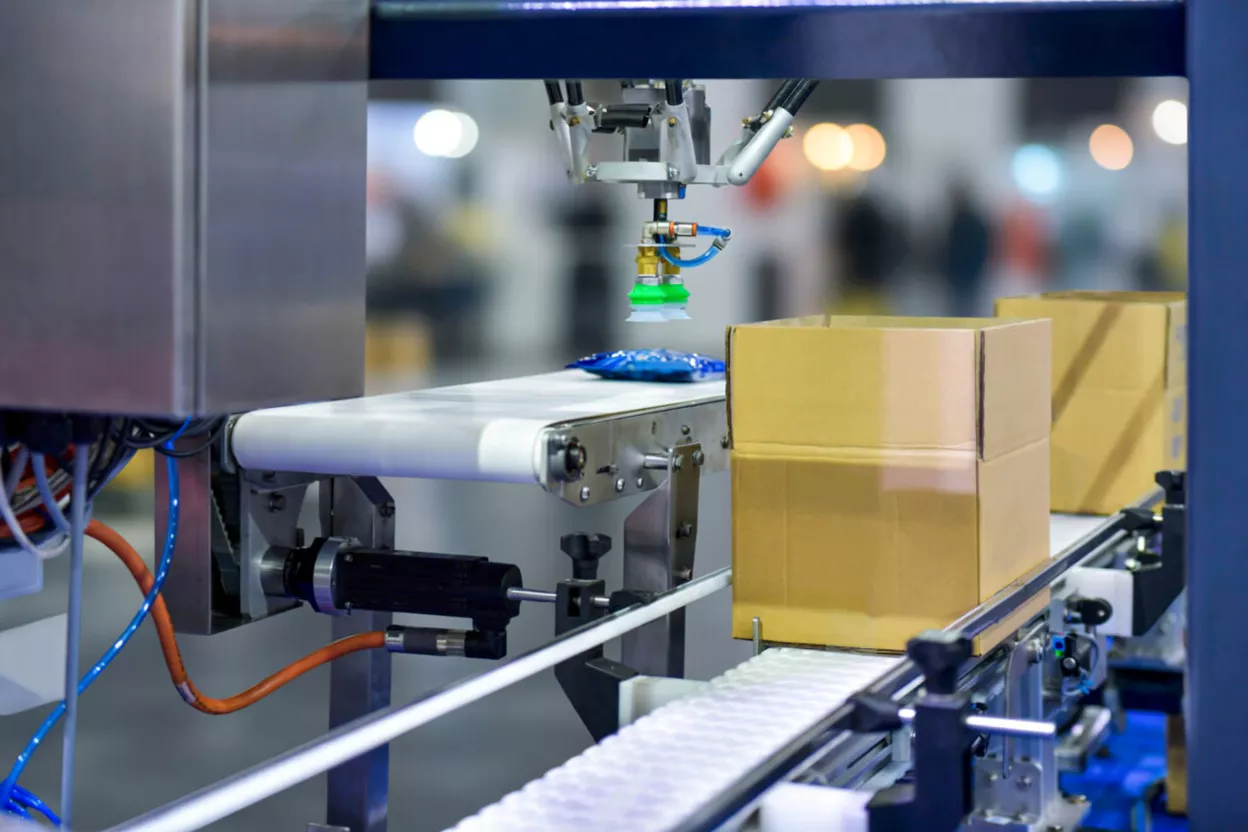
Where Worm Drives Fit in Cartoning & Palletizing Systems
Modern cartoning and palletizing lines integrate multiple motion axes, and worm reducers appear at several critical points:
A worm reducer drives the main cam shaft that erects flat carton blanks into open boxes. The key requirement is zero-backlash motion transfer — any angular play in the drive produces inconsistent fold geometry and jamming. We offer low-backlash (<0.5°) worm reducer configurations for this application.
Reciprocating push arms that batch-group products before loading into cartons. These axes cycle at 60–150 strokes/min with brief dwell at each end. The high inertia-matching capability of worm reducers — their output inertia is inherently decoupled from the motor shaft — prevents drive oscillation at high cycle rates.
A large-diameter turntable (800–1 400 mm) that rotates product layers 90° or 180° to build interlocking pallet patterns. The worm drive provides precise index positioning (±0.5°) and self-locking between index moves — no brake required to hold the loaded turntable during layer transfer.
Column-type robotic palletisers use a worm gear drive for the base slew axis — 270° rotation of the arm assembly. The self-locking characteristic of the worm drive provides inherent static holding between cycles, improving safety in human-collaborative zones.
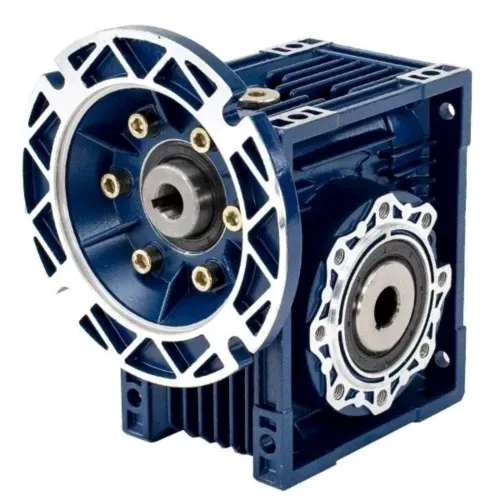
The worm wheel is manufactured from ZCuSn10Pb1 phosphor bronze, centrifugally cast for density uniformity. The housing is typically die-cast aluminium ADC12 for packaging machine applications — lighter weight and easier to integrate into the machine’s powder-coated fabricated frame. For heavy palletiser turntables, grey cast iron GJL-250 is preferred for its superior rigidity under the eccentric radial loads that asymmetric pallet layer patterns generate.
Technical Specifications — Cartoning & Palletising Worm Reducers
| Parameter | Full Range | Cartoning Machine | Palletiser Turntable |
|---|---|---|---|
| Gear Ratio | 5:1 – 100:1 | 10:1 – 30:1 | 40:1 – 80:1 |
| आउटपुट टॉर्क | 10 – 4 500 N·m | 20 – 200 N·m | 300 – 1 500 N·m |
| Backlash | Standard / Low (<0.5°) | Low-backlash preferred | Standard acceptable |
| Housing Material | Aluminium / Cast iron | Die-cast aluminium | Cast iron GJL-250 |
| Motor Flange | IEC B5 / B14 / NEMA C-face | IEC B14 (servo-compatible) | IEC B5 (large motor) |
| IP Rating | IP55 / IP65 | IP65 | IP65 |
| Self-Locking | Ratio ≥ 30:1 typically | Not required (cam drive) | Required — holds loaded turntable |
Service Factor: Cartoning cam drives — SF 1.25 (smooth, predictable load). High-speed pusher arms — SF 1.5 (inertia reversal). Palletiser turntable — SF 1.5 (eccentric layer loads). Contact engineering for VFD-driven servo-loop applications.
Standards & Certifications
Certified QMS — full production traceability
EU Machinery Directive 2006/42/EC
Direct servo & stepper motor coupling
Dust-tight; jet-water protected
Packaging-safe materials throughout
Five Cartoning & Palletising Case Studies
Why Packaging Machine OEMs Choose Us
High-Cycle Durability
Validated for 50+ million cycles on pusher and cam-drive applications — extended fatigue life through precision-ground worm shaft surface finish (Ra 0.4 µm).
Compact Right-Angle Form
90° input-to-output geometry fits cartoning machine frames where inline reducers simply cannot — the decisive packaging machine design advantage.
OEM / ODM Service
Custom IEC B14 flanges, special shaft stub lengths, low-backlash assembly, and private-label nameplate — all from a single supplier with 3D models on request.
Machine CE Documentation
CE declarations, ISO 9001 certs, material test reports, and dimensional drawings — exactly the documentation packaging OEMs need to CE mark their complete machines.
Frequently Asked Questions
What backlash level is acceptable for a cartoning machine cam drive?
For carton erection and folding cam drives, backlash below 0.5° is the practical target. Standard worm reducers typically show 0.8–1.5° of angular backlash at the output shaft. Our low-backlash assemblies (preloaded thrust bearing + tighter mesh clearance) achieve <0.4°. This is sufficient for all cartoning speeds up to 300 cpm. Above 300 cpm with servo positioning, consider a servo-grade worm reducer with backlash <0.2° — available on request.
Does a worm reducer self-lock reliably under an asymmetric palletiser layer load?
Yes — worm reducers with ratio ≥ 30:1 are self-locking under static conditions, meaning the output shaft cannot be back-driven by a static torque applied at the output. An asymmetric pallet layer (e.g., one side loaded heavier than the other) creates an overturning torque at the turntable output shaft, but as long as this does not exceed the reducer’s static back-drive torque threshold, the worm holds. We calculate this for your specific layer weight and eccentricity — provide your layer pattern and weight distribution for verification.
Can I connect a servo motor directly to a worm reducer for cartoning applications?
Yes — our IEC B14 flanged worm reducers accept servo motors directly via the precision-machined B14 face and pilot diameter. For servo applications, specify the low-backlash version and confirm that the servo motor’s peak torque (typically 3× rated) does not exceed the reducer’s peak torque rating. Also ensure the servo controller’s position feedback accounts for the reducer ratio — the encoder on the motor sees ratio × output shaft angle. We provide inertia ratio data sheets for servo matching calculations.
What is the expected service life of a worm reducer on a 24/7 cartoning line?
On a correctly sized cartoning cam drive (SF 1.25, synthetic lubricant, correct mounting orientation), our worm reducers routinely achieve 4–6 years of 24/7 operation before the first worm wheel rebuild. The limiting component is bronze worm wheel wear — gradual and predictable, not sudden failure. Monitoring oil colour (darkening indicates bronze wear particles) provides early warning. Annual oil change and semi-annual seal inspection are the only scheduled maintenance items.
Do you supply worm reducers that comply with NEMA motor dimensions for US-market machines?
Yes — we supply NEMA C-face compatible input flanges as an option on all standard frame sizes. NEMA 56C, 143TC, 145TC, 182TC, and 184TC face dimensions are available. For US OEM customers, we can ship units pre-assembled with a NEMA-frame motor if preferred. Specify the NEMA frame size and motor shaft diameter when ordering.
Accelerate Your Packaging Machine Development
Share your cartoning speed, cam shaft torque, or palletiser layer weight — we return a reducer selection, low-backlash specification, and 3D STEP model within 24 hours. No design delay, no guesswork.
Meet our team and factory at the हमारे बारे में page.